
Vehicle Assembly Business in Nepal through Foreign Direct Investment ("FDI")
Nepal offers a growing opportunity for foreign investors in motor vehicle assembly. Investors may establish assembly business using Semi-Knocked-Down (“SKD”) or Completely-Knocked-Down (“CKD”) components, with scope to progressively increase local value addition and manufacturing capacity.
This article outlines the legal framework, business models, FDI requirements, and approval process for establishing a vehicle assembly business in Nepal through FDI.
1. Governing Laws for Vehicle Assembly Business in Nepal
The major laws governing the establishment and operation of a vehicle assembly business through FDI include:
- Foreign Investment and Technology Transfer Act, 2019 (2075) and Foreign Investment and Technology Transfer Regulation, 2020 (2077);
- Industrial Enterprises Act, 2020 (2076) and Industrial Enterprises Rules, 2022 (2078);
- Companies Act, 2006 (2063);
- Environment Protection Act, 2019 (2076) and Environment Protection Rules, 2020 (2077);
- Foreign Exchange (Regulation) Act, 1962 (2019);
- Motor Vehicles and Transport Management Act, 1993 (2050) and Motor Vehicles and Transport Management Rules, 1997 (2054).
2. Procedure for Establishing a Vehicle Assembly Business in Nepal
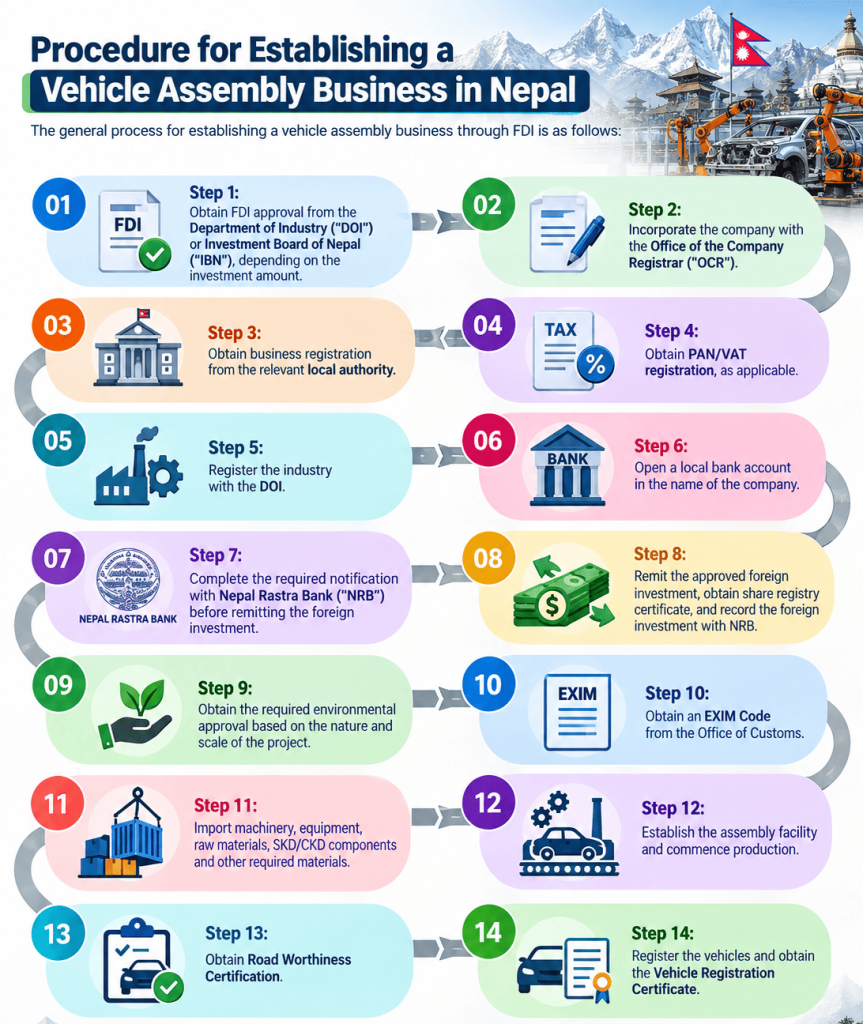
The general process for establishing a vehicle assembly business through FDI is as follows:
Step 1: Obtain FDI approval from the Department of Industry (“DOI”) or Investment Board of Nepal (“IBN”), depending on the investment amount.
Step 2: Incorporate the company with the Office of the Company Registrar (“OCR”).
Step 3: Obtain business registration from the relevant local authority.
Step 4: Obtain PAN/VAT registration, as applicable.
Step 5: Register the industry with the DOI.
Step 6: Open a local bank account in the name of the company.
Step 7: Complete the required notification with Nepal Rastra Bank (“NRB”) before remitting the foreign investment.
Step 8: Remit the approved foreign investment, obtain share registry certificate, and record the foreign investment with NRB.
Step 9: Obtain the required environmental approval based on the nature and scale of the project.
Step 10: Obtain an EXIM Code from the Office of Customs.
Step 11: Import machinery, equipment, raw materials, SKD/CKD components and other required materials.
Step 12: Establish the assembly facility and commence production.
Step 13: Obtain Road Worthiness Certification.
Step 14: Register the vehicles and obtain the Vehicle Registration Certificate.
3. Key Conditions for Vehicle Assembly Industry in Nepal
The vehicle assembly industry may be subject to fulfill following requirements:
i. Domestic value addition:
At least 10% in the first year, increasing to at least 30% by the end of five years.
ii. Employment:
At least 50 direct employees in the first year, increasing to at least 200 direct employees within five years.
iii. Domestic material content:
At least 10% domestic material content within five years, where applicable.
iv. Environmental and safety compliance:
The project may be subject to examination and approval relating to environmental protection, vehicle safety and technical standards.
4. Minimum Capital Requirement
The general minimum threshold for foreign investment approval is NPR 20 million per foreign investor, subject to applicable sector-specific requirements and exemptions.
5. Timeline for Establishment
Subject to the completeness of documents and the relevant regulatory approvals, the initial company incorporation and regulatory approval process may generally take approx.. 1 to 2 months.
However, establishment of the actual assembly facility will require additional time for factory arrangements, environmental approval, importation and installation of machinery, testing, vehicle certification and commencement of production.