
Child Adoption Process in Nepal by Nepali Nationality
Introduction
Adoption is a legal process in which if someone takes another person’s son or daughter as their own, that child shall be deemed an adopted son or daughter. Adoption must be effected in a manner that protects the best rights and interests of the child. The governing authority for adoption is the District Court of Nepal. This document sets out the adoption process in Nepal by the Nepali Nationality.
2. Governing Laws
Adoption in Nepal is governed by the National Civil Code, 2074 and the Muluki Civil Procedure Rules, 2075.
3. Eligibility of the Adopter
A person is eligible to adopt a child if they fall into one of the following categories:
(a) A married couple who have not had a son or daughter even after 10 years of marriage.
(b) An unmarried woman, widow, divorcee, or judicially separated woman who has attained the age of 45 years and has no son or daughter.
(c) An unmarried man, widower, divorcee, or judicially separated man who has attained the age of 45 years and has no son or daughter.
(d) A person who already has a biological son or daughter may adopt another child if the Court finds that the adopter has reasonable financial capacity to provide for the child’s maintenance, health care, education, and care.
4. Non-Eligibility of the Adopter
A person is not eligible to adopt a child in the following circumstances:
(a) A person who already has a son may not adopt a son, and a person who already has a daughter may not adopt a daughter except where the existing child does not live with the adopter due to judicial separation, in which case the adopter may adopt a son or a daughter.
(b) A person who is not of sound mind.
(c) A person who has been convicted by a court of a criminal offence involving moral turpitude.
(d) A person who does not have the financial capacity to afford the maintenance, health care, education, sports facilities, entertainment, and care of the minor.
5. Eligibility of the Adoptee
A child is eligible to be adopted subject to the following conditions:
(a) The adoptee must not have completed 14 years of age, except where the adoptee is within three generations of relation to the adopter, or is a son or daughter born to the ex-husband of the wife, in which case the person may be adopted even after completing 14 years of age.
(b) The adoptee must not be only son or daughter, except adoption of a adoptee whose father and mother are not traced or surviving or a child whose father and mother are surviving but who has been maintained or cared by a person or organization following the conclusion of another marriage either by his or her father or mother may be effected by obtaining written consent of the person or organization so maintaining or caring the child.
(c) The adoptee must not have been previously adopted as a son or daughter, unless that earlier adoption has been annulled according to law.
(d) The adoptee must not be in a higher degree of relationship than the person adopting.
(e) The adoptee must be a citizen of Nepal, including a non-resident Nepali citizen who has obtained foreign citizenship may still be adopted.
6. Joint Eligibility of Adopter and Adoptee
The age difference between the adopter and the adoptee must be at least 25 years, except in the case of adoption of a person within three generations of relation.
7. Consent Required for Adoption
7.1. Consent from the Adopter’s Side:
A husband or wife living in a joint family must obtain each other’s consent before adopting.
7.2. Consent from the Adoptee’s Side
(a) The adopter must obtain the written consent of both the father and mother of the child, if both are surviving; or of the surviving father or mother, if only one is surviving.
(b) Where the father and mother are separated due to dissolution of marriage or judicial separation, and the child lives with one parent under the terms of that separation, the adopter must obtain the consent of the parent with whom the child has been living.
(c) Where the child’s father and mother cannot be traced or are not surviving, or where a surviving parent has placed the child in the care of another person or organization following another marriage, adoption may proceed with the written consent of that caring person or organization.
(d) If the adoptee is above 10 years of age, the child’s own written consent is required, given in the presence of their father, mother, guardian, or curator exercising parental authority.
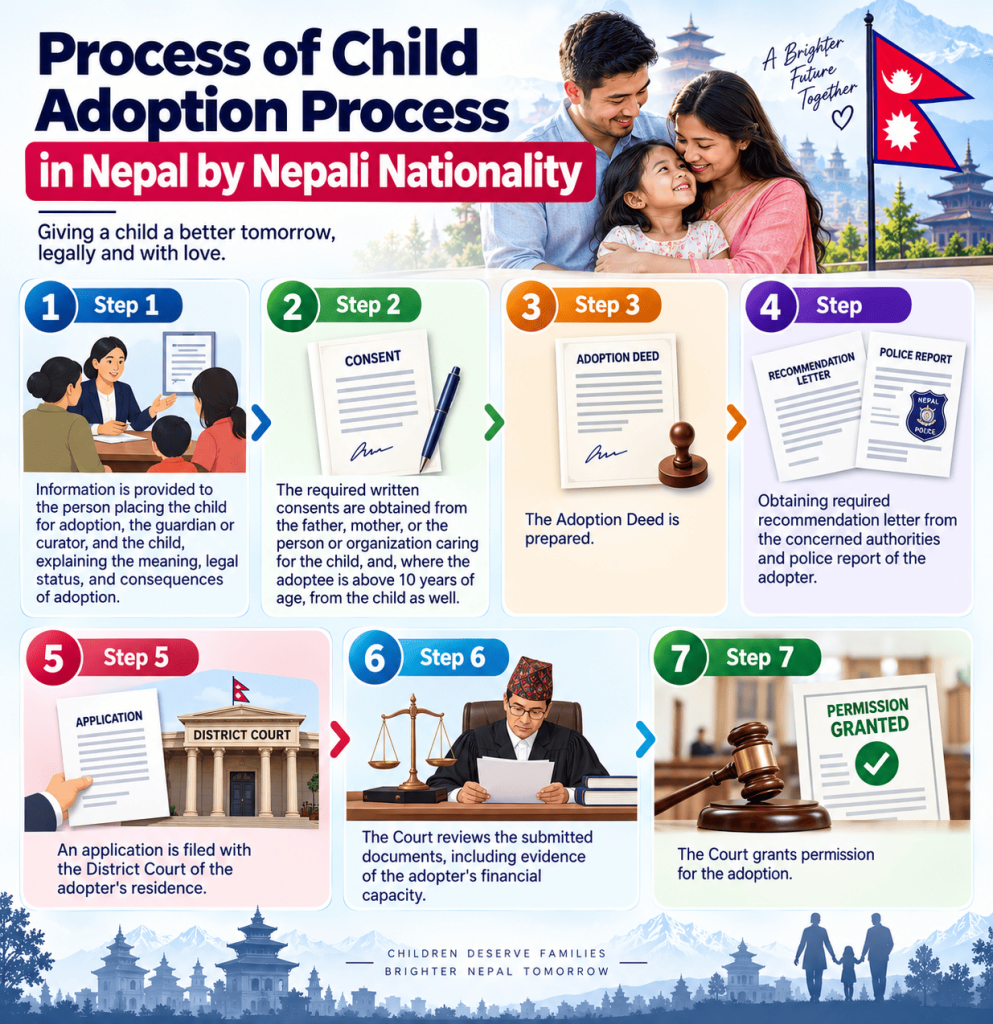
8. Process of Child Adoption in Nepal by Nepali Nationality
Step 1: Information is provided to the person placing the child for adoption, the guardian or curator, and the child, explaining the meaning, legal status, and consequences of adoption.
Step 2: The required written consents are obtained from the father, mother, or the person or organization caring for the child, and, where the adoptee is above 10 years of age, from the child as well.
Step 3: The Adoption Deed is prepared.
Step 4: Obtaining required recommendation letter from the concerned authorities and police report of the adopter.
Step 5: An application is filed with the District Court of the adopter’s residence.
Step 6: The Court reviews the submitted documents, including evidence of the adopter’s financial capacity.
Step 7: The Court grants permission for the adoption.
9. Document Requirements
The following documents are generally required for the adoption process:
- Copy of the citizenship of the adopter.
- Copy of the birth certificate or citizenship of the adoptee.
- Consent letter of the adopting parent(s) or adopter.
- Consent letter of the adoptee child (if above 10 years of age).
- Consent letter of the adoptee’s father, mother, guardian, or curator exercising parental authority.
- Documents evidencing the adopter’s financial status, including movable or immovable property.
- Recommendation letter for adoption from the adopter’s concerned ward.
- Passport-sized photographs (3 copies each) of the adopter, the adoptee, and the child’s parents.
- The Adoption Deed.
- Copies of the citizenship of two witnesses.
- A recent, notarized police report of the adopter.
- Marriage registration certificate of the adopting husband and wife.
- Documentation regarding the adopter’s inability to have, or lack of, a child.
- Document verifying the relationship between the family members of the adoptee.
10. Entitlements and Rights of an Adoptee
(a) An adopted son or daughter holds the same entitlements, rights, obligations, and responsibilities as a biological son or daughter of the adoptive parent.
(b) An adopted son or daughter may use the surname of either or both adoptive parents, or of their biological father or mother.
11. Obligations of the Adopter
(a) To arrange for the maintenance, health care, sports, entertainment, and proper education of the adoptee, according to the adopter’s reputation and financial capacity, as if the adoptee were their biological child.
(b) To protect the rights and interests of the adoptee.
(c) To provide the adoptee with the opportunity to visit and correspond with their biological father and mother from time to time.
12. Obligations of the Adoptee
(a) To arrange for the maintenance, health care, and care of the adoptive parent, according to the adoptee’s reputation and capacity, as if that person were their natural father or mother.
(b) To protect, look after, and properly manage the property of the adoptive parent.
(c) To protect the rights and interests of the adoptive parent.